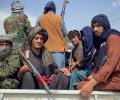
Pakistan confirms its armed forces targeted terrorist hideouts and military installations in Afghanistan's Kandahar province, claiming the action was in response to attacks by the Afghan Taliban. The strikes, part of Operation Ghazab lil-Haq, targeted technical support infrastructure and equipment storage used by terrorists, according to Pakistani officials.
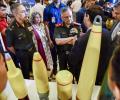
'General Subramani's appointment as military adviser in the NSCS has given him insight into decision-making at the apex level prior to formally taking over as CDS.'

The United States has ordered the withdrawal of non-emergency staff from its consulates in Karachi and Lahore, Pakistan, citing security concerns amid regional tensions and protests.

The Metropolitan Police in London are increasing patrols and resources following a series of antisemitic attacks, including an incident targeting a Jewish charity. Counter-terrorism officers are investigating the attacks, which are suspected to be linked to an Islamist group with ties to Iran.
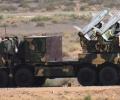
India's defence sector is on the cusp of a 'super cycle' of growth, driven by escalating geopolitical conflicts and a strong policy push towards indigenous manufacturing, with major players like BEL, HAL, and BDL poised for significant order inflows and technological advancements.

The deployment could include infantry and armoured units, in addition to the 82nd Airborne Division, which is already stationed in the region.

US defence officials confirmed that an F-35 did perform an emergency landing after an Iranian surface-to-air missile (SAM) barrage, with the pilot safe and an investigation underway.
United States carried out the heaviest bombing so far of Pakistan's lawless tribal belt as a swarm of drones fired a volley of 19 hellfire missiles at the den of the fighters of Haqqani network, killing 31 militants, including two Taliban commanders and several foreign fighters.

Fight on toward goals that keep receding, or exit with most objectives unmet. Trump is agitated, his poll numbers falling below the Plimsoll line, his base fractured between those who back the war and those who remember that he campaigned on ending them.

The Lebanese army has begun evacuating some of its forward positions along the border with Israel and redeploying troops to other posts, Lebanon's state-run National News Agency (NNA) reported on Tuesday, amid intensified Israeli military activity in the area.
The United States has put its covert air campaign that targets al-Qaeda and Taliban operatives in Pakistan's tribal agencies "on hold", in the wake of strained ties between the two countries.
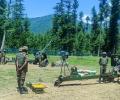
'India's security challenges are no longer confined to the Line of Control or the Line of Actual Control.'
'They also span cyber networks, economic systems, information warfare, technology ecosystems, maritime routes, and internal social cohesion.'

'India's ties with Israel have to do with defence and general technology.' 'The war changes nothing in what India and Israel hope to get from the relationship.' 'It's not as though India will get significantly more benefits from Iran if India abandons Israel at this time.'

The IRGC also warned residents to evacuate areas near military bases, security centres and government facilities.

Iran has launched a fresh wave of missile attacks against Israeli and United States-linked targets as the Islamic Revolutionary Guard Corps (IRGC) said it fired some of its heaviest missiles in the latest phase of its retaliatory campaign, while Israel Defence Forces alleged that many of the projectiles carried cluster bomb warheads.

Pakistan has announced a temporary pause in its ongoing operation against the Afghan Taliban in response to requests from Islamic countries and in view of the upcoming Eid festival, following accusations from Afghanistan regarding an attack on a rehabilitation hospital in Kabul.

What we are watching is something different: A fog manufactured and maintained by the people who started the war, so that the question of why it was started never has to be answered, observes Prem Panicker in his must read blog on the war in the Middle East.

'Without ground troops the US will not be able to oust the Iranian Islamic regime. Political change does not happen just by using bombs or planes.'

Trump emphasised that diplomatic discussions remain ongoing. At the same time, he issued a stark warning, saying that failure to reach an agreement could trigger military action.

IDF international spokesperson Lt Col Nadav Shoshani said the Israeli military targeted several Hezbollah positions, including command and control centres, launch sites and senior operatives.
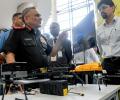
Chief of Defence Staff General Anil Chauhan emphasizes the importance of self-reliance in Unmanned Aerial Vehicles (UAVs) and Counter-Unmanned Aerial Systems (C-UAS) for India, citing recent global conflicts and Operation Sindoor as examples of their strategic importance.

The escalating conflict involving the U.S. and Israel with Iran has led to widespread disruption in the world of sports, with events postponed, travel plans thrown into chaos, and athletes seeking asylum.

The delegations from the US and Iran head to Islamabad on Friday, carrying a ceasefire that is already fraying, a Strait that is technically open and practically closed, and a negotiating agenda that would challenge even parties actually negotiating in good faith, which these groups are not. Prem Panicker continues his must read blog on the Iran War.
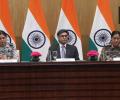
Colonel Sofiya Qureshi revealed that 300 to 400 drones were deployed across 36 locations, with several being shot down by Indian forces using both kinetic and non-kinetic methods.

The Kuwaiti Defence Ministry said all crew members of the crashed aircraft ejected safely and were taken to a hospital for medical check-ups.

Pakistan's Information Minister claims nearly 800 Afghan Taliban terrorists have been killed in Operation Ghazab lil-Haq, launched in response to cross-border firing.

The Indian Army's Air Defence units successfully shot down multiple Kamikaze drones launched by Pakistan after they crossed the International Border in Punjab's Amritsar early Saturday morning. The drones, identified as Byker YIHA III models, were carrying high-explosive payloads and were headed towards densely populated civilian areas. The incident highlights the efficiency of India's multi-layered air-defence system.

'TTP has vowed to take revenge for the attacks that Pakistan is carrying out against Afghanistan.' 'To diminish this threat, Pakistan is hitting Afghanistan hard.'
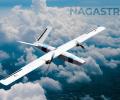
The foremost lesson for India today is to beef up its air defence to cater for multiple drone attacks. As seen in Operation Sindoor, we have come a long way, but there's room for getting better. We must develop a robust and almost impregnable air cover over ourselves, asserts IAF veteran Air Commodore Nitin Sathe (retd).
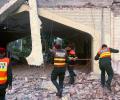
Pakistan's military claims to have shot down several drones launched by India, while also reporting injuries to four soldiers in a drone attack. India denies the attacks and claims to have foiled Pakistani attempts to engage military targets.

AI reduces the time taken to find a target and launch a strike. This has led to a major increase in the pace of the conflict, with one report mentioning nearly 900 strikes launched on Iranian targets in the first 12 hours of an operation.

EaseMyTrip co-founder Rikant Pitti advises travelers to stay flexible and monitor airline updates due to airspace closures and route diversions following strikes on Iran.

The Israel Defence Forces (IDF) confirmed the missile launches in a statement on Telegram, noting that defensive systems were actively operating to intercept the threat.

Indian Grandmaster Koneru Humpy has withdrawn from the FIDE Women's Candidates Tournament, citing concerns over her personal safety amidst the West Asia conflict.

Tensions escalated dramatically on March 5, 2026, as the United States and Israel launched coordinated strikes on Iran, triggering retaliatory explosions across Tehran, Sanandaj, and beyond.

Indian Grandmaster Koneru Humpy is uncertain about competing in the Candidates Tournament in Cyprus due to safety concerns amid the West Asia conflict, despite assurances from FIDE.

Iran's Islamic Revolutionary Guard Corps (IRGC) claims control of the Strait of Hormuz and reports striking a US destroyer, escalating tensions in the Middle East following retaliatory strikes between Iran, the US, and Israel.

United States President Donald Trump on Friday signalled the US intention of going all out in its campaign against Iran's Islamic regime, warning Iran to watch out for what would happen today and saying that the US was winning the conflict despite what reports claimed.

'After we were alerted about the war, none of us could sleep for the next two nights while sailing through those waters.'

Iran striker Sardar Azmoun has been left out of the squad for World Cup warm-ups amid reports of expulsion over alleged disloyalty, sparking controversy.
